


THE PHILOSOPHY
Music is a language to be lived,
not just a subject to be studied.
We don't learn our first language by memorising every rule before speaking.
We listen, imitate, experiment, and gradually learn to express ourselves.
I believe music can be learned in the same way, by developing the ability to hear, understand and express music for yourself.


I didn't find the path all at once
My journey with music has never been just about learning the notes.
Through years of playing, teaching, and experimenting, I've discovered that understanding music goes far beyond following instructions.
I've explored different ways to practise, develop musical skills, and help students overcome obstacles. Some approaches worked better than others.
Now, I share what I've learned along the way,
so you can discover a path that works for you.
Classically trained pianist · Leeds Conservatoire graduate · 10+ years of teaching experience
A map of the skills behind the music
Over the years, I've found that piano difficulties often become easier to understand when we look beyond the piece we're practising and identify the underlying skill.
I organise these discoveries into four foundations. They help me understand where a player is, what may be holding them back, and which direction to explore next.
Understand how music fits together
Harmony
-
Understand chords, keys, and progressions
-
Move between them with intelligence, not memory
-
Hear why they work, not just what they are
-
Build the vocabulary that makes freedom possible
Finger Fitness
Tension is audible before it's visible
-
Eliminate physical tension and stiffness
-
Build hand independence and coordination
-
Make technique feel effortless, not forced
-
Remove the physical ceiling on your playing
Melody
Turning notes into sentences
-
Develop phrasing and musical articulation
-
Learn to shape a line, not just play one
-
Express what you hear in your head
-
Turn a sequence of notes into a speech
Rhythm
-
Develop a real internal pulse
-
Stop rushing, stop dragging, stop counting
-
Feel the beat instead of calculating it
-
The foundation most pianists underestimate the most
These four foundations contain 16 individual skills.
Not a fixed route everyone must follow, but a map to help us understand what to work on next
What makes playing feel alive.
Every pianist has a different path.


Some pianists understand music intellectually but struggle to translate that understanding into movement.
Others learn quickly by ear but find reading or consistency more difficult.
These are just a few examples. Every pianist has a different combination of strengths and obstacles.
Whichever one you are, the language is the answer.
Student stories
Story 1: Finding understanding

Faye's journey towards understanding harmony and the music behind the notes.
Student story · Faye
Story 2: Finding control

A pianist working on finger independence developed clearer runs and greater control in challenging passages.
Student story · Ashley
Story 3: Finding creative freedom
Jay's journey beyond Grade 8, exploring new styles and developing a more expressive musical identity.
Student story · Jay
Student achievements:
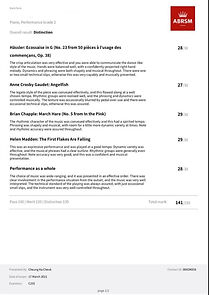


These results reflect more than exam preparation.
They represent the musical understanding, listening skills and expressive playing we develop together along the way.
Other positive feedbacks


These results reflect more than exam preparation.
They represent the musical understanding, listening

Now, tell me your piano story.
Let's walk the next chapter together.
Wherever you are on your piano journey, I'd like to hear your story.
Maybe you're just starting out, returning after years away, feeling stuck, or ready to explore music beyond the exam room. Whatever your situation, let's figure out your next step together.